
Why I Buy Used Camera Gear (And You Probably Should Too)

Updated: Jul 22
People ask me all the time,
"How do professionals afford all their expensive equipment?"
Simple. We aren't pre-ordering every camera announcement because YouTube got excited.
Sure, the celebrity photographers and brand ambassadors do that. But for the everyday blue collar professionals, that's not reality.
In fact, as photographers working for profit, professionals are probably the most obsessed with carefully buying used equipment and slashing costs.
One of the biggest financial mistakes I see new photographers make is assuming they need all their gear new in box. Many have the mindset that their gear is somehow contaminated if someone has used it.
Pros don't think about gear emotionally. They think about cost of ownership.
Once you prioritize cost of ownership, you'll realize the used gear market is one of photography's best-kept secrets, while buying new is often one of its biggest financial traps.
The 70-200 f/2.8 Example
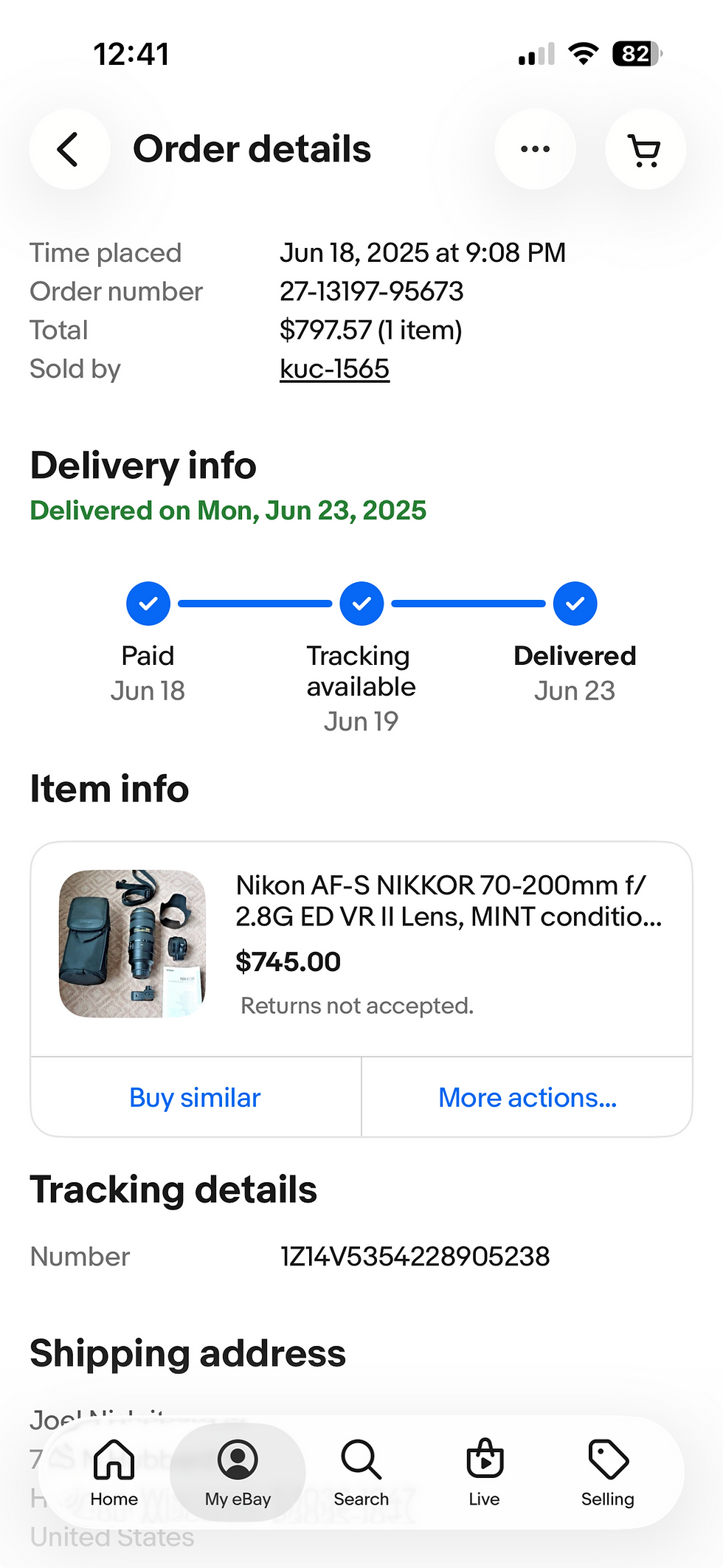
Last year I bought a used Nikon 70-200mm f/2.8 VR II for $797. It even came with an FTZ II adapter. This week, about a year later, I sold the lens on eBay for $760.
Before fees, I essentially paid $37 to use a professional telephoto lens for an entire year... and I still kept the FTZ II adapter.
Sweet!

Turning a Nikon Z7 into a Z9
The $38, 70-200 f/2.8 upgrade wasn't a lucky transaction. It's a repeatable strategy.
A few years ago I bought a used Nikon Z7 for $1,400. I used it for roughly two years, and then sold it for $1,000. That's a gross cost of ownership of about $200 per year for a professional full-frame mirrorless camera.
I then rolled that $1,000 into a used Z9 at $3,100. So instead of financing a new Z9 for $5,500, I paid out of pocket $2,000 for a used one. Years later, I'm still getting massive value out of that Z9.
That's how I think about gear. Now compare that to financing a brand-new $5,000 camera, even at 0% interest. You still have to come up with the full $5,000. A few years later, it may only be worth $2,800 or $3,000. You didn't pay interest, but you still paid thousands in depreciation. Zero percent financing doesn't eliminate the biggest cost. It simply spreads it out over time. Don't restart your collection with every purchase. Roll your equity forward into field-proven gear at a lower cost, and your financial margins will stay wider.
Instead of feeding depreciation, you can invest where it actually improves your photography:
Better glass.
Workshops. Classes.
Travel.
Prints.
Let someone else absorb the depreciation. You capture the value.
"But What About the Warranty?"
This is probably the biggest objection I hear. Honestly... it's not nearly the risk most people think it is.
Let's look at what buying new actually gets you.
The moment you leave the return window, your gear is immediately worth used prices. About a year later, the factory warranty is gone. Even while it's active, accidental damage usually isn't covered.
So if warranty is the main reason you're buying new, you're paying a significant premium to protect yourself against one of the least likely outcomes.
The most likely outcome? The camera works exactly as designed -- for many years.
If you buy carefully from reputable sellers and choose equipment that's already proven in the field, chances are you'll never need the factory warranty.
And if the extra peace of mind of a warranty matters to you, many used dealers offer inexpensive protection plans that often include accidental damage, which is even better than a factory warranty. Even after adding that coverage, you're still frequently spending a lot less than buying new.
Pro Advice
How can you afford expensive gear? Don't be flashy. It's not what pros do.
Buy used carefully. Maintain your equipment. Then, when it's time to upgrade, sell what you have and roll that money into the next purchase.
Think less about the emotional satisfaction of new-in-box gear and more about cost of ownership. It's one of the smartest financial habits I've developed as a photographer.
I cover exactly how I evaluate used gear, avoid bad purchases, and think about equipment as part of a long-term photography plan inside my Lightspeed membership.
Because I'd rather invest in creating better photographs than in subsidizing depreciation.
Comments